
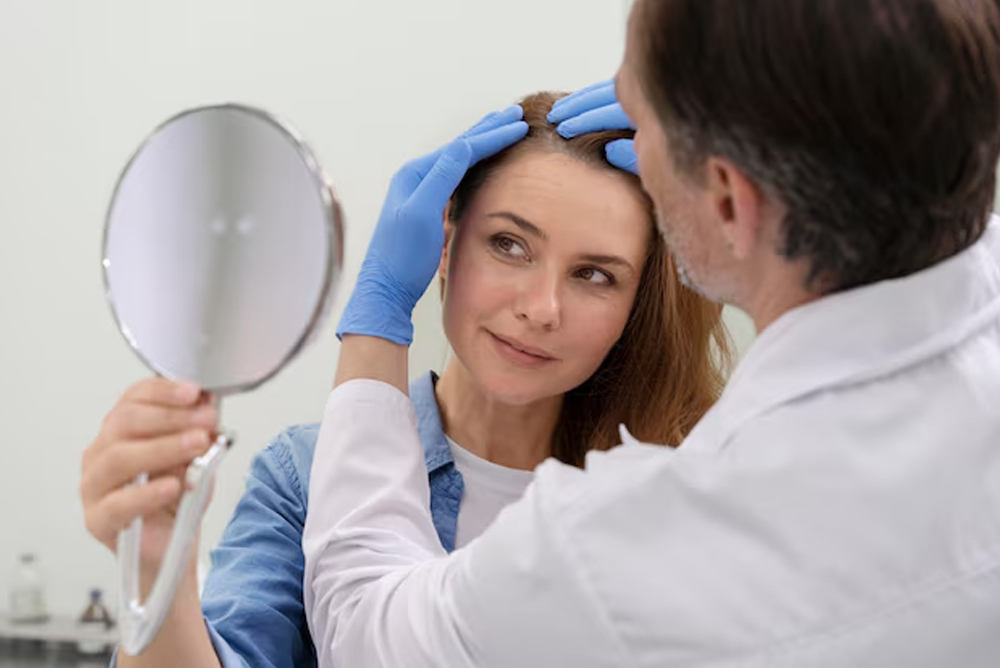
Why Am I Losing Hair? A Dermatologist’s Guide to Female Pattern Hair Loss, PCOS & Advanced Treatments
Hair thinning in women is one of the most emotionally distressing concerns seen in dermatology practice.
Many women notice widening of the hair part, reduced hair volume, or excessive shedding and fear permanent baldness.
The most common reason behind this gradual thinning is Female Pattern Hair Loss (FPHL) — a medically recognized and treatable condition.
At Arshi Skin and Hair Clinics, we approach female hair loss scientifically — identifying the root cause,
evaluating hormonal health, and designing personalized treatment protocols that restore hair density and confidence.
What is Female Pattern Hair Loss (FPHL)?
Female Pattern Hair Loss, also called female androgenetic alopecia, is a chronic, progressive condition characterized by:
- Gradual thinning over the crown
- Widening of the central parting
- Reduced hair density
- Miniaturization of hair follicles
Stages of Female Pattern Hair Loss (Ludwig Classification)
Stage I – Early Thinning:
Slight widening of the central part with mild reduction in density.
Stage II – Moderate Thinning:
Visible scalp under bright light and noticeable volume reduction.
Stage III – Advanced Thinning:
Diffuse thinning over crown with significant decrease in hair volume.
Causes of Female Pattern Hair Loss
- Genetic predisposition
- Hormonal imbalance and increased androgens
- Polycystic Ovary Syndrome (PCOS)
- Thyroid disorders
- Nutritional deficiencies (iron, vitamin D, B12)
- Chronic stress
Types of PCOS
- Insulin-Resistant PCOS – Associated with weight gain and high insulin levels.
- Inflammatory PCOS – Linked to chronic inflammation.
- Adrenal PCOS – Elevated adrenal hormones such as DHEAS.
- Post-Pill PCOS – Temporary hormonal imbalance after stopping contraceptives.
Difference Between PCOS and PCOD
PCOD refers to ovarian dysfunction where immature eggs accumulate in ovaries.
PCOS is a broader endocrine-metabolic syndrome involving significant hormonal imbalance and insulin resistance.
Hair loss is more strongly associated with PCOS due to androgen excess.
Investigations at Arshi Skin and Hair Clinics
- Digital trichoscopy and scalp density analysis
- Complete blood count
- Serum ferritin
- Vitamin D3 and B12
- Thyroid profile
- Fasting insulin
- LH/FSH ratio
- Serum testosterone and DHEAS
- Pelvic ultrasound when indicated
Treatments for Female Pattern Hair Loss
Medical Therapy:
Topical minoxidil, anti-androgen therapy such as spironolactone, and nutritional supplementation.
PRP Therapy:
Uses patient’s own growth factors to stimulate dormant follicles and improve thickness.
GFC Therapy:
Advanced growth factor-based therapy offering standardized concentration.
Low-Level Laser Therapy:
Improves scalp circulation and follicular health.
Hair Transplant:
Considered in advanced stable cases with adequate donor density.
Latest Advancement – Exosome Therapy
Exosomes are nano-sized extracellular vesicles derived from stem cells containing growth factors and regenerative signals.
They help stimulate follicular stem cells, reverse miniaturization, reduce inflammation, and improve density.
Exosome therapy shows promising results especially when combined with PRP or GFC.
Why Early Treatment Matters
Early intervention preserves follicles, slows progression, and improves long-term outcomes.
Conclusion
Female Pattern Hair Loss is progressive but manageable. With proper diagnosis, hormonal correction,
and advanced regenerative treatments available at Arshi Skin and Hair Clinics,
healthy and fuller hair is achievable. Hair restoration is not just cosmetic — it restores confidence and quality of life.
For expert evaluation and personalized treatment of Female Pattern Hair Loss, PCOS & Advanced Treatments contact Arshi Skin and Hair Clinics and book a consultation today.
