
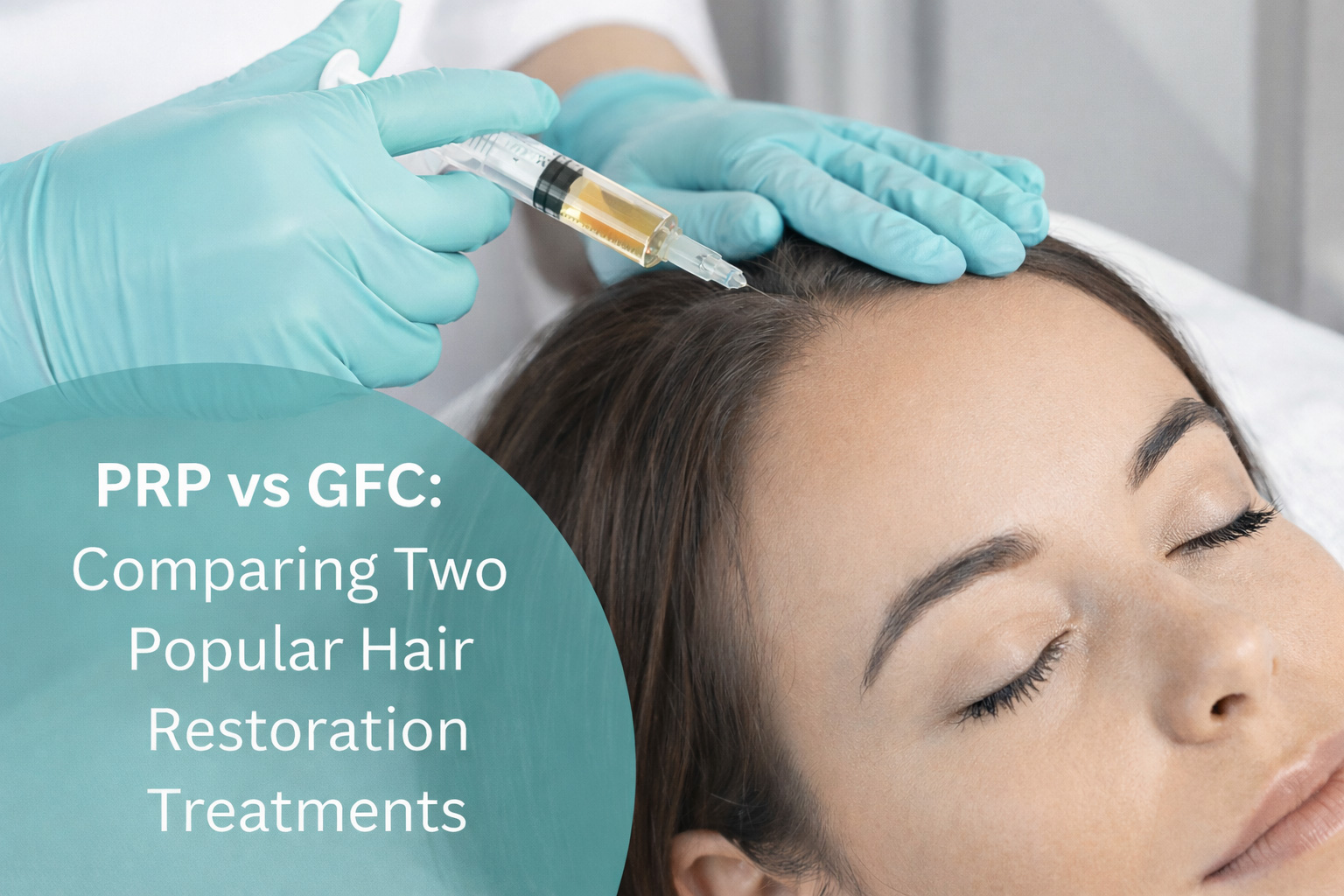
Is Growth Factor Concentrate (GFC) really different from PRP? — a dermatologist’s perspective
DR.T.Annapurna
ARSHI SKIN AND HAIR CLINICS
M.B.B.S,DDVL,FRGUHS,MA-PSYCHOLOGY.
Dermatologist,Dermatosurgeon & Aesthetic medicine physician
Platelet-rich plasma (PRP) has been widely adopted in dermatology for hair restoration, scar remodeling, skin rejuvenation and pigmentary disorders. In recent years a close cousin — variously called growth factor concentrate (GFC), concentrated growth factors (CGF) or platelet-derived growth factor concentrates — has been promoted as an “upgraded” option. As a practicing dermatologist I get asked repeatedly: Are these fundamentally different? Is GFC markedly better than PRP? Short answer: no — GFC is not hugely different from PRP; it is a variation on the same autologous theme, with methodological tweaks intended to concentrate and/or release growth factors in different ways. Below I explain the science, practical methodology, evidence (with PubMed/PMC references) and realistic clinical benefits — so you can understand from an evidence-based standpoint.
Brief physiology: why platelets and growth factors matter
Both PRP and GFC rely on autologous blood as the starting material. Platelets contain alpha granules loaded with bioactive proteins (PDGF, TGF-β, VEGF, EGF, IGF-1, FGF etc.) that promote angiogenesis, cell proliferation, extracellular matrix remodelling and stem cell activation.
When platelets are activated or lysed at the injection site these factors are released and can modulate follicular stem cells (in hair loss) or dermal fibroblasts and keratinocytes (in skin rejuvenation). That basic biology underpins both PRP and GFC approaches.
Definitions and the practical difference: PRP vs GFC/CGF
PRP (Platelet-Rich Plasma)
PRP (Platelet-Rich Plasma) — broadly: plasma fraction with a supraphysiological platelet count obtained by centrifuging whole blood. PRP preparations vary (leukocyte-rich vs leukocyte-poor, single vs double spin, activated vs non-activated), and this variability explains much of the inconsistent outcomes across studies.
Typical PRP injectate contains intact platelets suspended in plasma; platelets are activated in situ (by tissue collagen or added activator) to release growth factors over a relatively short window.
GFC / CGF (Growth Factor Concentrate / Concentrated Growth Factors)
GFC / CGF (Growth Factor Concentrate / Concentrated Growth Factors) — these are modifications of PRP techniques designed to:
- (a) yield a plasma/serum fraction with high concentrations of soluble growth factors
- (b) reduce cellular debris or leukocytes (depending on protocol)
- (c) pre-activate platelets so that the product contains more freely available growth factors (rather than intact platelets).
Some GFC protocols perform specialized centrifugation and then mechanically or chemically induce platelet degranulation, collecting the supernatant (the growth factor-rich fluid) rather than the intact platelet pellet. In other words, GFC often delivers growth factors in a more “ready” form; PRP delivers intact platelets that release growth factors after injection.
Clinical takeaway: conceptually both approaches supply the same molecular toolkit — growth factors and cytokines. The primary difference is how (and over what time course) those factors are delivered: PRP = intact platelets that release factors over hours–days; GFC = more immediate availability of soluble growth factors. But the end biological signals are largely overlapping.
Methodology: how I (as a dermatologist) perform/understand GFC vs PRP
Below is a practical, clinic-level protocol overview. Exact centrifuge speeds/times will depend on the kit; the key is the principle.
A. PRP (common double-spin leukocyte-poor example)
- Draw 15–60 mL autologous blood into anticoagulant (ACD-A or citrate).
- First spin (soft spin): separates RBCs from plasma and buffy coat.
- Collect plasma + buffy coat into a sterile tube.
- Second spin (hard spin): concentrates platelets into a pellet; remove platelet-poor plasma (PPP), resuspend pellet in a small plasma volume to achieve desired concentration (commonly 3–6× baseline).
- Inject intradermally/intralesionally/scalp using micro-injections or needling.
B. GFC (typical approach used in studies)
- Draw similar blood volume but sometimes into plain tubes or tubes designed for specific centrifugation programs.
- Centrifuge using a protocol that yields a distinct platelet-rich layer and a PRP-serum fraction. Some GFC methods deliberately activate platelets before or during collection (e.g., by CaCl₂ or specific mechanical disruption) so that the collected fluid is rich in soluble growth factors and has fewer intact platelets.
- Collect the supernatant growth factor concentrate (the fluid that contains released GFs) — this is the GFC. Concentrations of EGF, PDGF, VEGF may be measured in some labs.
- Inject similarly to PRP (intradermal/intralesional/scalp), often combined with microneedling to increase penetration.
Why choose one over the other in practice?
- GFC may be preferred when you want an immediate bolus of soluble growth factors and when you want to avoid injecting many intact platelets.
- PRP may be preferred when seeking a sustained local release (platelet-mediated) and when leveraging the fibrin scaffold effect.
But crucially, both approaches are compatible with adjuncts like microneedling, low-level laser therapy, minoxidil/finasteride (in AGA), or topical agents — and combined approaches often outperform monotherapy.
Evidence: what studies tell us
There are randomized and prospective studies for both modalities — but the literature is uneven and often small. A few representative findings:
- Multiple systematic reviews and randomized trials support PRP efficacy for androgenetic alopecia (AGA) and some applications in skin rejuvenation.
- Several prospective studies and case series report GFC benefits for hair (AGA), melasma, acne scarring and nasolabial fold volume improvement.
- A 2022–2024 cluster of observational studies and small trials suggest GFC is promising in AGA and other pigmentary/texture disorders.
- Analytical studies show considerable variability in growth factor concentrations between PRP preparations.
Clinical takeaways from the evidence
- Both PRP and GFC have supportive data for hair regrowth and skin indications, but evidence quality varies.
- GFC can be more consistent in growth factor content, but superiority over PRP is not universally proven.
- Standardization and larger RCTs are needed.
Benefits and realistic expectations (what I tell my patients)
Shared benefits (PRP & GFC):
- Autologous (very low risk of allergy or transmissible infection when processed correctly).
- Can stimulate hair regrowth or increase hair shaft thickness in AGA.
- Improve skin texture, collagen remodeling and mild scar revision.
- Minimal downtime, office-based procedure.
Limitations and realistic expectations:
- Neither PRP nor GFC is a magic bullet.
- Outcomes depend on patient factors and concurrent therapies.
- Cost, equipment and operator experience matter.
Safety profile and contraindications
- Mild transient pain, erythema, swelling can be expected; rarely infection if asepsis breaks down.
- Avoid in patients with platelet dysfunction syndromes, on anticoagulants, active scalp infection, or unrealistic expectations.
Bottom line — closing, evidence-based answer
- Are GFC and PRP fundamentally different? No — they are variations on the same autologous growth-factor therapy.
- Is GFC “hugely” better than PRP? Current evidence does not support a sweeping claim of superiority.
References (selected PubMed / PMC papers)
- Sevilla GP, et al. Safety and Efficacy of Growth Factor Concentrate in the Management of Nasolabial Folds.
- Gentile P, et al. The Effect of Platelet-Rich Plasma in Hair Regrowth.
- Sthalekar B, et al. Prospective Study of Growth Factor Concentrate Therapy for Melasma.
- Siah TW, et al. Growth factor concentrations in platelet-rich plasma for hair growth.
- Kobayashi E, et al. Comparative release of growth factors from PRP, PRF, and other concentrates.
- Steward EN, et al. Efficacy of PRP and concentrated growth factors (CGF) with microneedling in AGA.
- Garg S, et al. Clinical and Trichoscopic Analysis of PRP Versus GFC in Patterned Hair Loss.
